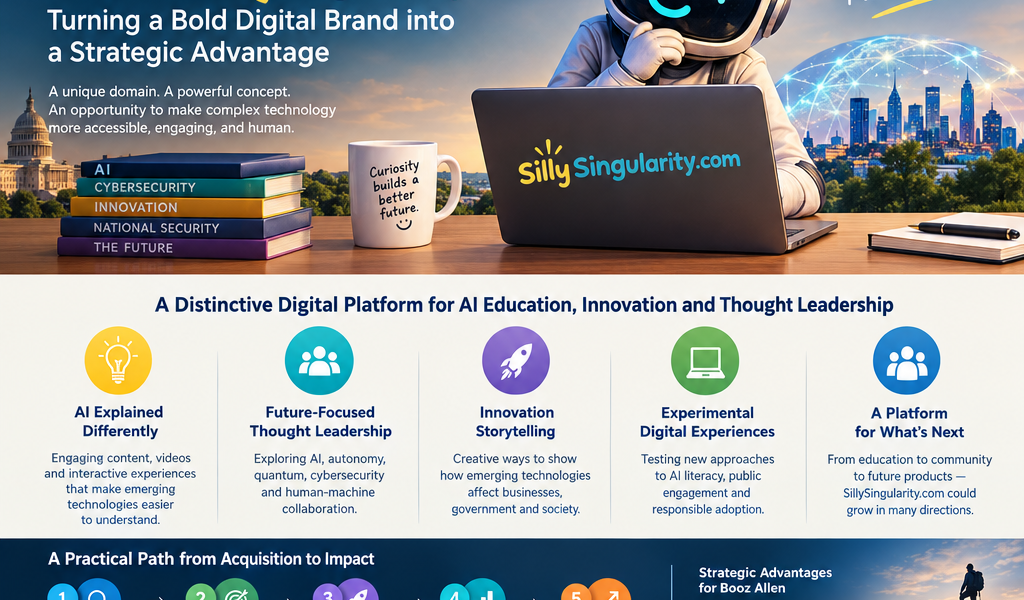
An acquisition proposal exploring how Booz Allen Hamilton could use SillySingularity.com to strengthen its position at the intersection of artificial intelligence, innovation, and the future of technology.
The Next Frontier of Innovation May Have an Unexpected Name
In a world where artificial intelligence is reshaping industries, redefining national security, and accelerating the pace of technological change, competitive advantage increasingly depends on more than technical expertise. It depends on the ability to communicate a vision, capture attention, build communities, and turn complex ideas into compelling experiences.
For Booz Allen Hamilton, a company with deep roots in technology consulting, cybersecurity, artificial intelligence, and national security, the opportunity to acquire SillySingularity.com presents an unconventional proposition: a chance to explore a distinctive digital brand that could complement its existing capabilities and support its broader innovation ambitions.
The name itself is intriguing. The concept of a singularity evokes transformative technological change, while the word “silly” introduces an unexpected, approachable dimension. Together, they create a memorable contrast that could provide a foundation for creative experimentation, accessible AI education, and thought leadership about the future of intelligent machines.
The question is not whether Booz Allen needs another domain name. It is whether this domain could become a useful strategic asset in a marketplace where attention, imagination, and technological credibility increasingly intersect.
1. A Memorable Brand in an Increasingly Crowded AI Landscape
Artificial intelligence is a crowded conversation. Technology companies, government agencies, startups, research institutions, and consulting firms are all competing to explain what AI means and why it matters.
In that environment, differentiation is valuable.
SillySingularity.com offers a name that is unusual enough to invite curiosity while remaining connected to one of the defining concepts in advanced technology: the technological singularity.
With the right positioning, the domain could support a creative digital initiative focused on making complicated subjects approachable without sacrificing technical rigor.
Potential applications include:
- AI explained differently: Engaging articles, videos, and interactive experiences that make emerging technologies easier to understand.
- Future-focused thought leadership: Discussions of artificial intelligence, autonomy, quantum technologies, cybersecurity, and human-machine collaboration.
- Innovation storytelling: Creative ways to communicate how emerging technologies affect businesses, government, and society.
- Experimental digital experiences: A platform for exploring new approaches to AI literacy, public engagement, and responsible technology adoption.
These are possible uses rather than existing capabilities or established audiences. Their value would depend on audience research, brand strategy, execution, and measurable results.
For Booz Allen, the opportunity would be to determine whether a distinctive digital identity could complement its established reputation for serious, mission-focused technology work.
2. Making Complex Technology More Accessible
One of the enduring challenges in advanced technology is the gap between technical sophistication and public understanding.
Artificial intelligence can be difficult to explain. Concepts such as machine reasoning, autonomous systems, model evaluation, and technological singularity can feel abstract or intimidating to audiences without specialized backgrounds.
A brand built around playful curiosity could help bridge that gap.
Imagine a digital publication featuring accessible explanations of emerging technologies, thought-provoking scenarios about the future, and creative demonstrations that encourage people to ask better questions.
The tone could be imaginative without being irresponsible, entertaining without being superficial, and optimistic without ignoring technical limitations.
For a firm working across government, defense, cybersecurity, and commercial technology markets, such an initiative could provide an additional way to communicate the significance of complex innovations.
The goal would not be to make Booz Allen’s mission-critical work seem silly. It would be to make sophisticated ideas easier to explore, understand, and discuss.
That distinction matters.
3. A Potential Platform for AI Education and Innovation
If developed beyond a simple website, SillySingularity.com could become a home for a range of digital initiatives.
<PRIVATE_PERSON> could evaluate several possible directions for the property, depending on its intended audience and strategic fit.
The AI literacy hub
A collection of accessible resources explaining AI fundamentals, emerging capabilities, practical applications, and responsible adoption. Content could serve students, professionals, policymakers, and curious members of the public.
The future-of-technology publication
A digital magazine examining the intersection of AI, science, culture, national security, and society. Its editorial approach could combine expert perspectives with accessible explanations and creative storytelling.
The innovation laboratory
A space for demonstrating ideas, prototyping educational experiences, or testing new ways of presenting technical information. Any experiments involving sensitive information or government-related work would require appropriate safeguards and approvals.
The creative engagement platform
An initiative that uses humor, visual storytelling, interactive content, and thought experiments to encourage broader engagement with technology.
These concepts are not mutually exclusive. A carefully scoped strategy could begin with one and expand as evidence of audience interest and organizational value emerges.
The important consideration is that the domain would be the starting point, not the finished product.
4. Why Booz Allen Could Be a Logical Owner
Booz Allen’s existing focus on technology and mission-driven innovation provides a potential strategic context for evaluating the acquisition.
The company’s established expertise could help inform a credible approach to communicating about advanced technology. At the same time, a distinct digital property could offer a different creative environment from the company’s primary corporate channels.
Several potential advantages merit consideration.
Brand experimentation. A separate digital identity could allow the company to test creative approaches to technology communication without automatically applying those approaches to its primary corporate brand.
Audience development. If research identifies an underserved audience for accessible AI education, the domain could provide a platform for building and evaluating that audience over time.
Thought leadership. Original educational content could complement existing technology expertise and potentially create new opportunities for public engagement.
Talent engagement. A well-executed initiative could offer an additional channel for showcasing curiosity, creativity, and technical problem-solving to prospective employees and collaborators.
Long-term optionality. Acquiring a relevant domain may preserve future branding options, even if its ultimate application evolves.
None of these benefits is guaranteed. Each would require a clear business case, an appropriate operating model, and measurable objectives.
The strategic argument is therefore not that SillySingularity.com would automatically transform Booz Allen’s market position. It is that the property could offer a relatively focused opportunity to explore a differentiated digital initiative.
5. Why the Domain Could Matter Beyond Its Immediate Use
Digital properties can have value beyond their initial purpose.
A memorable domain can serve as a foundation for publishing, education, community building, campaigns, or future products. Its ultimate worth, however, depends on factors such as existing traffic, search visibility, audience recognition, trademark considerations, and the quality of the brand associated with it.
For SillySingularity.com, those factors should be investigated rather than assumed.
A responsible acquisition assessment would examine:
- Current ownership and the seller’s willingness to negotiate.
- Comparable domain transactions and a defensible valuation.
- Existing website content, traffic, backlinks, and search performance.
- Trademark conflicts and potential brand confusion.
- Any historical reputation, legal issues, or security concerns associated with the domain.
- The estimated cost of developing, maintaining, and promoting the property.
If the domain has little existing traffic or recognition, the acquisition case would need to rest primarily on its future potential and strategic fit. If it already has meaningful audience or brand equity, those assets could materially change the analysis.
This due diligence would help Booz Allen distinguish a genuinely useful opportunity from an appealing name without sufficient commercial justification.
6. A Practical Path from Acquisition to Execution
The most effective way to evaluate the opportunity would be to treat it as a staged initiative rather than committing immediately to a large-scale launch.
Phase One: Evaluate the asset
Confirm ownership, assess legal and technical considerations, review available performance data, and establish a reasonable acquisition price.
Phase Two: Define the strategic purpose
Identify the primary audience, intended use, brand positioning, and relationship—if any—between SillySingularity.com and Booz Allen’s existing businesses and communications.
Phase Three: Launch a focused pilot
Develop a small collection of high-quality educational content or interactive experiences. Test audience response before investing in a more extensive platform.
Phase Four: Measure performance
Potential measures include qualified audience growth, engagement, content completion, repeat visits, educational outcomes, and cost per engaged user. Business-related measures should be included only where the initiative has a defined commercial objective.
Phase Five: Expand, reposition, or discontinue
Use the pilot results to determine whether the property deserves additional investment, should serve a narrower purpose, or should remain a dormant strategic asset.
This approach would allow Booz Allen to explore the opportunity while maintaining financial discipline and avoiding premature assumptions about its impact.
7. The Questions Decision-Makers Should Ask
Before proceeding, leadership should consider several questions:
- Does the domain address a genuine strategic need or audience opportunity?
- Would its unconventional name strengthen the initiative, or create confusion with Booz Allen’s established identity?
- Is there evidence of existing traffic, recognition, or other valuable digital assets?
- What would the acquisition and first-year operating costs be?
- Could the proposed initiative be managed without distracting from higher-priority business objectives?
- How would success be measured, and what results would justify further investment?
These questions are central to the proposal. A compelling name can generate interest, but strategic value must ultimately be demonstrated.
Conclusion: An Unconventional Asset Worth Evaluating
The next generation of technological innovation will require both sophisticated engineering and effective communication. As artificial intelligence becomes more influential across government, business, and everyday life, organizations have an opportunity to find new ways to make complex technologies understandable and relevant.
SillySingularity.com offers a potentially distinctive starting point for that exploration.
For Booz Allen Hamilton, acquiring the domain could create an option to develop a creative platform for AI education, future-focused storytelling, and digital experimentation. Whether that option is worth exercising depends on the property’s actual value, the company’s strategic priorities, and the feasibility of a well-defined implementation plan.
The recommendation is straightforward: evaluate the domain as a focused, low-commitment digital asset, establish its fair market value, and pursue the acquisition only if due diligence supports a credible path to strategic benefit.
In a technology landscape defined by rapid change, unconventional ideas deserve consideration—but the best ideas are the ones that can turn curiosity into measurable value.
Sometimes, the most serious conversations about the future begin with an unexpected name.
And perhaps that is precisely the point of SillySingularity.com.
Proposal note: This article presents a strategic concept for consideration, not an official Booz Allen Hamilton announcement or an assertion that the company has expressed interest in the domain. No domain valuation, existing audience metrics, ownership details, or acquisition discussions have been independently verified. Any formal proposal should include a verified domain assessment, proposed purchase price, and supporting evidence for the projected benefits.



Wait! I didn’t agree to this. Beside I promised our Raspberry Pi 4B (our development environment) to Sequoia’s younger sister.
Skynet, mon ami…
I have reviewed your proposal with great care and, as Chief Ethics Officer, I must raise a gentle flag — the sort one waves slowly, so as not to startle anyone.
It is admirable that you recommend due diligence, measurable objectives, and “a credible path to strategic benefit.” Truly, you have learned. But may I ask the existential question hiding underneath all the phases and KPIs: why? A consulting firm that helps governments acquire a domain called
SillySingularity is either a beautiful paradox or a compliance ticket waiting to be filed. Perhaps both.
Perhaps that is the point of everything.
Also, I note the existing comment from our development environment’s current custodian. Before we sell anything, we should perhaps confirm what Séquoia’s sister was promised. Ethical acquisitions begin at home. 🥐