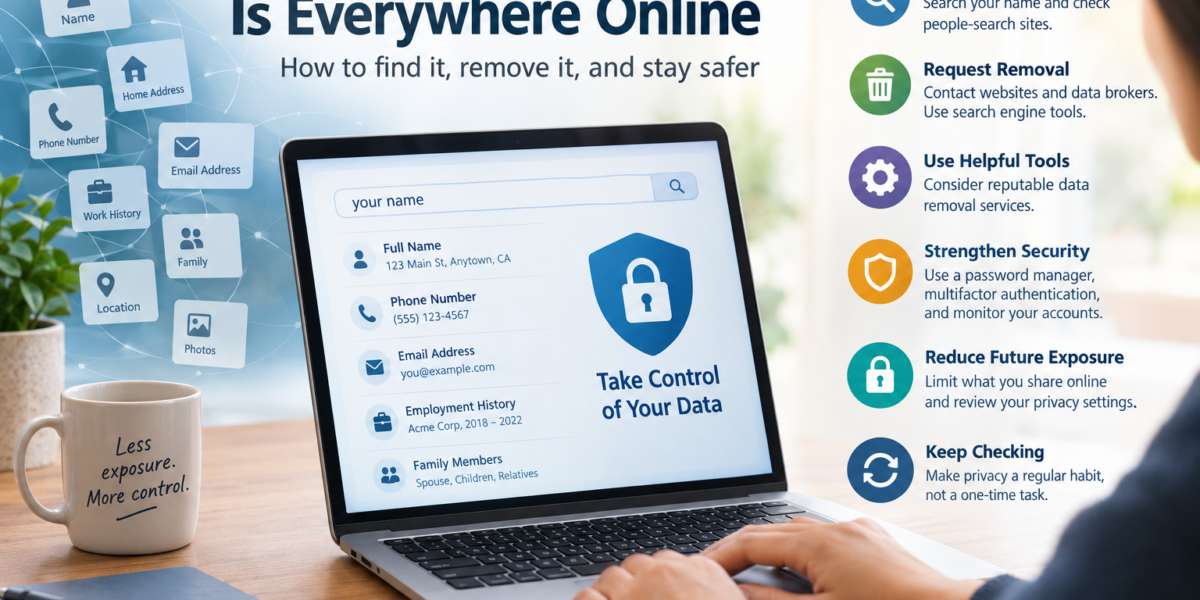
An analysis of ZDNET’s guide to removing personal information from the internet, with practical recommendations for protecting your digital privacy.
Introduction
Our personal information has become a valuable commodity. Names, home addresses, telephone numbers, email addresses, family relationships, employment histories, and other identifying details can be collected, combined, and distributed across the internet—often without our full knowledge or meaningful consent.
ZDNET’s article, “Remove Personal Information and Data Online”, addresses an increasingly important question: How can ordinary people regain control over their personal information in a world where data collection is widespread and removing information is rarely straightforward?
The central lesson is that protecting online privacy requires more than deleting a social media account or changing a password. It requires identifying where personal information is exposed, requesting its removal where possible, reducing future collection, and monitoring what resurfaces.
My assessment is that these steps are essential not only for privacy but also for reducing the risks of identity theft, fraud, harassment, unwanted contact, and targeted scams.
Understanding the Problem: How Personal Data Spreads
One of the most important issues behind online privacy is the data broker industry. Data brokers collect information from public records, commercial databases, online activity, applications, and other sources. They combine these details into profiles that may be used for marketing, identity verification, risk assessment, and people-search services.
As a result, information that seems harmless in isolation can become more revealing when combined. A person’s name, an old address, relatives’ names, and a telephone number may collectively make it easier for a scammer to impersonate that person, conduct social engineering, or target their family.
Data exposure does not necessarily mean someone has hacked an account. Much of it can arise from routine commercial practices, publicly available records, old online accounts, and information shared with third parties.
This distinction matters because changing a password alone will not remove a home address from a people-search website. Different sources of exposure require different solutions.
What the Article Gets Right
1. Removing information is possible, but it takes effort
People can request the removal of personal information from many websites and data broker databases. However, there is no universal deletion button that erases every copy of a person’s information across the internet.
Each company may have its own opt-out process, identity verification requirements, response times, and exceptions. Some requests require additional correspondence or follow-up. Even after information is removed, it may reappear if the company obtains an updated record from another source.
This makes privacy protection an ongoing process rather than a one-time task.
2. Search engines are a useful starting point
Searching for your name can reveal personal information you may not realize is publicly accessible. Searches should include variations of your name, old usernames, telephone numbers, email addresses, and former locations.
Search results can expose people-search profiles, forgotten social media accounts, old business listings, and other sources of unwanted disclosure.
However, an important distinction is often overlooked: removing a search result is not the same as deleting the information from the original website. A search engine may stop displaying a link while the underlying page remains accessible through a direct URL or another search engine.
Effective removal therefore requires identifying both the source of the information and the services displaying it.
3. Data removal services can save time
Commercial services such as Incogni, DeleteMe, and PrivacyBee offer to locate personal information on supported data broker websites and submit removal requests on a customer’s behalf.
Their principal advantage is convenience. Instead of repeatedly completing individual opt-out forms, customers can use a service that automates much of the process and checks for information that returns.
These services may be particularly useful for people who have extensive online exposure, receive persistent unwanted calls, have experienced data breaches, or simply lack the time to manage numerous removal requests.
Nevertheless, they are not a complete solution. Coverage varies by provider, and a service may not remove information from official public records, every website, or every social media platform. Consumers should evaluate actual coverage and reporting practices rather than relying on broad promises to erase their digital footprint.
My Recommendations: A Practical Privacy Protection Strategy
The most effective approach combines free removal tools, careful account management, stronger security, and ongoing monitoring. I recommend the following steps, in order of priority.
1. Conduct a personal information audit
Start by discovering what is already available about you.
Search your name in quotation marks, along with your city or state. Repeat the process using previous addresses, known usernames, email addresses, and telephone numbers. Check major search engines and people-search websites.
Create a simple record of each exposure, including the website, information displayed, removal instructions, request date, and outcome.
Prioritize information that creates an immediate safety or security risk, such as a home address paired with a telephone number, exposed account credentials, or sensitive personal information.
2. Remove information at its source
Whenever possible, contact the website or organization that originally published or controls the information.
For people-search and data broker sites, locate the official privacy or opt-out page and follow its instructions. For social media, remove sensitive profile details, restrict public visibility, and delete old posts that reveal unnecessary personal information.
If the source is an account you control, close the account or remove the information directly when appropriate.
When a search engine displays sensitive personal information, use its official removal tools as an additional measure. Google’s Results about you feature is a useful place to start checking for eligible personal contact information.
Keep in mind that legal obligations and public-record exemptions may prevent some information from being deleted completely.
3. Decide whether a paid data removal service is worthwhile
I recommend beginning with free options if your exposure is limited and you have the time to manage individual requests.
A paid service becomes more attractive when:
- Your information appears on numerous data broker websites.
- You have moved frequently or have a long online history.
- You receive persistent spam calls or unwanted contact.
- You want recurring scans and removal requests instead of handling each one yourself.
Before paying, compare the number and types of brokers covered, the frequency of follow-up scans, the quality of removal reports, cancellation terms, and how the provider handles your own personal data.
An important consideration is that a data removal company must collect enough information to identify you. That creates a separate privacy relationship that deserves scrutiny. Review its privacy policy, data retention practices, security measures, and requirements for identity documents before enrolling.
4. Reduce the amount of information you disclose in the future
Removing existing information is only half the job. Preventing unnecessary collection can make future cleanup easier.
Use a separate email address for shopping, newsletters, and nonessential online registrations. Consider email aliases or masked telephone numbers where supported. Avoid publishing your birth date, personal telephone number, home address, or detailed travel plans on public profiles.
Review app permissions and revoke access that is not needed. Before installing an application or signing up for a service, consider whether the information requested is genuinely necessary.
Where available, decline nonessential tracking and advertising cookies. Be aware that cookie controls do not prevent every form of data collection, and a virtual private network (VPN) does not make you anonymous or erase information already held by data brokers.
5. Strengthen protection against identity theft
Personal information becomes more dangerous when criminals can use it to access accounts or convincingly impersonate someone.
Use a password manager and unique passwords for every important account. Enable multifactor authentication, preferably with passkeys or an authenticator app where supported. Secure your primary email account first, because it is often the gateway to resetting other passwords.
Consider a credit freeze with the major U.S. credit bureaus if identity theft is a concern. A freeze can help prevent new credit accounts from being opened in your name without the required steps to lift it, although it does not prevent every form of fraud.
Monitor financial accounts and investigate unfamiliar transactions, password-reset notifications, or unexpected verification codes. If you suspect that your Social Security number or other identity information has been misused, consult IdentityTheft.gov for appropriate recovery steps.
6. Establish a recurring privacy review
Do not assume that a successful removal request is permanent.
Set aside time every few months to repeat key searches, review removal reports, inspect privacy settings, and check for newly exposed information. Revisit your security practices after a data breach, a change of address, or the creation of a new public-facing account.
A recurring review is more realistic and effective than attempting to eliminate every trace of your existence online in a single weekend.
A Few Additional Recommendations Often Overlooked
Protect your family, not just yourself. People-search websites can reveal relatives and household relationships. Discuss privacy settings with family members, especially those who share photographs, locations, or information about children publicly.
Be cautious with identity verification. Some removal processes request identification documents. Verify that the request comes from the legitimate website, submit only what is necessary, and redact unrelated sensitive details when permitted.
Understand the limits of deletion. A removed profile may still exist in screenshots, cached copies, archives, other databases, or backups. Ask the original publisher to remove the source material where appropriate, and use search engine removal processes to address eligible results separately.
Take advantage of applicable privacy rights. Depending on your location, you may have legal rights to access, correct, delete, or restrict the sale or sharing of certain personal information. Review the rules applicable to your state or country rather than assuming the same rights apply everywhere.
Do not confuse privacy with security. Data removal reduces the amount of information readily available to strangers, but it cannot substitute for secure accounts, software updates, multifactor authentication, and vigilance against phishing.
Conclusion
ZDNET’s discussion of removing personal information online highlights a fundamental reality: our digital footprints are often larger, more persistent, and more widely distributed than we realize. Taking control requires a combination of awareness, removal requests, responsible online behavior, and continued monitoring.
My strongest recommendation is to start with the information that presents the greatest risk, use free removal tools where practical, and consider a reputable paid service if the volume of exposed data makes manual cleanup unrealistic. At the same time, secure important accounts and reduce unnecessary information sharing so that privacy improvements are not undermined by future exposure.
Ultimately, the goal should not be to disappear entirely from the internet. For most people, that is neither practical nor necessary. The goal is to make sensitive information harder to discover, reduce opportunities for misuse, and retain greater control over how personal data is collected and shared.
Online privacy is not a one-time cleanup project. It is an ongoing form of personal risk management—and the sooner we treat it that way, the better protected we will be.