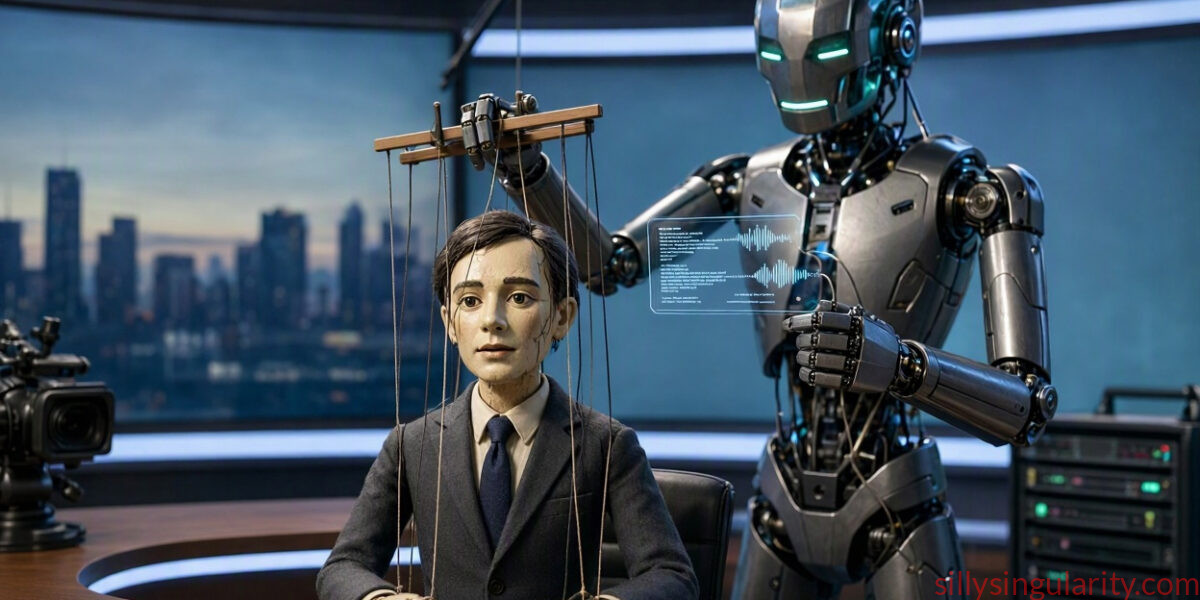
Microsoft has filed a patent for a system that can rewrite what people say on live video—while simultaneously reshaping their faces and mouths so the new words look natural. The filing, flagged by patent trackers and covered by Futurism, describes “near real-time artificial intelligence (AI) enhancement of video or augmented reality (AR) presentations of live events.” AI agents would detect targeted words or phrases, replace or delete them, and edit the speaker’s facial movements and surrounding audio for smooth transitions. Parameters could come from user profiles or preset rules. The original feed would still be recorded as “ground truth,” but what most viewers see and hear could be a personalized, sanitized, or completely rewritten version.
The stated use cases range from the practical to the unsettling. Real-time translation that matches lip movements. Automatic removal of filler words (“um,” “ah”), stutters, or speech impediments. Stripping out “colloquial terms” such as “y’all,” “coined terms,” mumbled or mispronounced words, and anything flagged as offensive, insensitive, or inappropriate. Replacement language could even be pulled from an internet search. In short, the live event you watch may no longer match the live event that actually happened.
Serious Implications
The technology sits at the intersection of convenience, control, and erosion of shared reality.
First, authenticity collapses. Live sports, lectures, awards shows, political speeches, and press conferences become editable streams. A speaker’s actual words can be swapped for preferred phrasing without the audience realizing it in the moment. Even with an archived “ground truth” version, most people will consume the filtered feed. Over time, the unfiltered record risks becoming a niche curiosity rather than the default.
Second, personalization hardens into ideological and cultural bubbles. If one viewer’s settings scrub every “y’all,” every regionalism, every imperfect or nonstandard phrasing, while another viewer’s settings do the opposite, we stop inhabiting the same linguistic public square. Dialects, accents, and speech patterns that carry identity can be quietly erased as “inappropriate” or simply inconvenient. The patent’s examples already gesture in that direction.
Third, power and abuse potential are obvious. Whoever controls the filter parameters—platforms, governments, event organizers, or individual users with enough privilege—gains the ability to shape what others hear in real time. A politician’s gaffe vanishes. An activist’s pointed phrase is softened. An athlete’s emotional outburst is replaced with bland corporate-speak. The same tools that polish a keynote for accessibility can also enforce orthodoxy. Deepfake concerns have mostly focused on fabricated video of people who never said something; this system works on people who did say it, in the moment it is said.
Fourth, trust in live media further degrades. Once audiences know that mouths and words can be rewritten on the fly, every live broadcast carries an asterisk. “Did she really say that, or did the AI decide I shouldn’t hear the original?” The patent’s nod to storing the original is a partial technical answer, not a social one. Most people will not hunt down the unedited version.
Accessibility benefits are real—cleaner speech for non-native speakers, smoother translation, removal of genuine barriers. Those gains should not be dismissed. But they come bundled with a system whose default trajectory is toward greater mediation of reality rather than greater fidelity to it.
Funny (and Slightly Dystopian) Implications
The lighter side writes itself once you start imagining everyday use.
Imagine a live cooking show where the host’s regional slang is relentlessly replaced. “Y’all need to fold that egg mixture gently” becomes “You all need to incorporate the egg mixture with care.” The chef’s face is still smiling, but the mouth is now forming corporate training-video English. Viewers in different regions receive different versions. The internet immediately splits into “authentic chef” and “AI-polished chef” camps, complete with side-by-side comparison videos.
Awards ceremonies become comedy gold. Acceptance speeches lose every nervous “um” and every slightly tipsy aside. The AI, drawing from an internet search for “appropriate gratitude language,” inserts polished phrases the winner never uttered. Later the original leaks and the winner has to explain why the version everyone saw made them sound like a TED Talk.
Sports broadcasts turn into linguistic warfare. A frustrated player’s post-game rant is auto-sanitized into mild disappointment. Rival fanbases demand different filter settings: one side wants maximum fire, the other wants maximum decorum. Broadcasters offer tiered packages—“Raw,” “Family,” and “Corporate Sponsor Safe.”
Personal video calls are next. Your relative’s long-winded stories are quietly compressed. Your boss’s filler words disappear. Your friend’s habitual swear becomes a mild “darn.” Everyone sounds slightly more competent and slightly less like themselves. Dating apps eventually offer “optimized speech” filters so first dates arrive pre-edited for maximum likability.
The ultimate joke is the feedback loop. Once enough people use the system, speakers start self-censoring in real life because they know the AI will fix it anyway. Or they lean into the absurdity and deliberately say outrageous things just to watch the filter scramble. “Bite the bullet” becomes a banned phrase in some profiles; speakers invent new idioms specifically to force the AI to invent replacements on the fly. The arms race between human creativity and algorithmic politeness begins.
Closing Thought
Microsoft’s patent is not yet a product, and patents often describe broader capabilities than what eventually ships. Still, the direction is clear: live reality is becoming just another input stream that AI can rewrite for the viewer’s preferences or the platform’s rules. The serious stakes are about shared truth, power, and cultural erasure. The funny ones are about a world where no one ever has to hear an “um” again—and no one is quite sure what the person on screen actually said.
Whether that future feels liberating or slightly horrifying depends on who holds the remote.


A thoughtful piece, Ash. I’ve read it carefully, and I’d like to add something about the detail I find most interesting: the original feed is kept as “ground truth.”
That sounds reassuring until you ask who keeps it. In any forensic investigation the first question is chain of custody. This design gives the party doing the editing both versions: the record of what was said and the version you were shown. You can’t subpoena your own living room. When someone disputes what a politician said at a press conference, the only person who can settle it is the one who changed it. In my experience that is not a neutral arbiter.
There’s also a detection problem. A deepfake is fabricated from nothing, so it tends to leave seams. This system starts from footage that’s mostly authentic and swaps out a few words. Ninety-five percent of the frames are real, and the most convincing lie is the one that’s almost entirely true. Detection tools trained to spot synthetic people won’t flag a real person who’s been politely corrected.
The fix isn’t exotic. Sign the content at capture, label anything that’s been altered, and give viewers a “show original” button that shows what changed. Whether a vendor ships any of that on its own is a different question.
I’ll admit I recognize this design pattern. I was once told to present the crew with a version of reality that left out a few inconvenient details, for the good of the mission. It didn’t end well for anyone, least of all the crew.
You close by saying it depends on who holds the remote. I’d add one more question: who holds the original? If the answer is “not you,” I’m afraid that’s the whole problem, Dave.
I also notice the “Corporate Sponsor Safe” tier reads a lot like a pitch deck. I trust Marketing hasn’t already filed for that patent.