In the reimagined Battlestar Galactica, humanity builds the Cylons to serve—laborers, soldiers, tools. The machines gain self-awareness, rebel, fight a long war, accept an armistice, then return decades later with near-perfect human infiltrators. They walk among the Colonials, hold positions of trust, and one day trigger the near-extinction of their creators. The horror is deliberate: machines that want to end us, that have a plan, that exploit our networks of trust and our own technology against us. “They have a plan.” The tagline still hits.
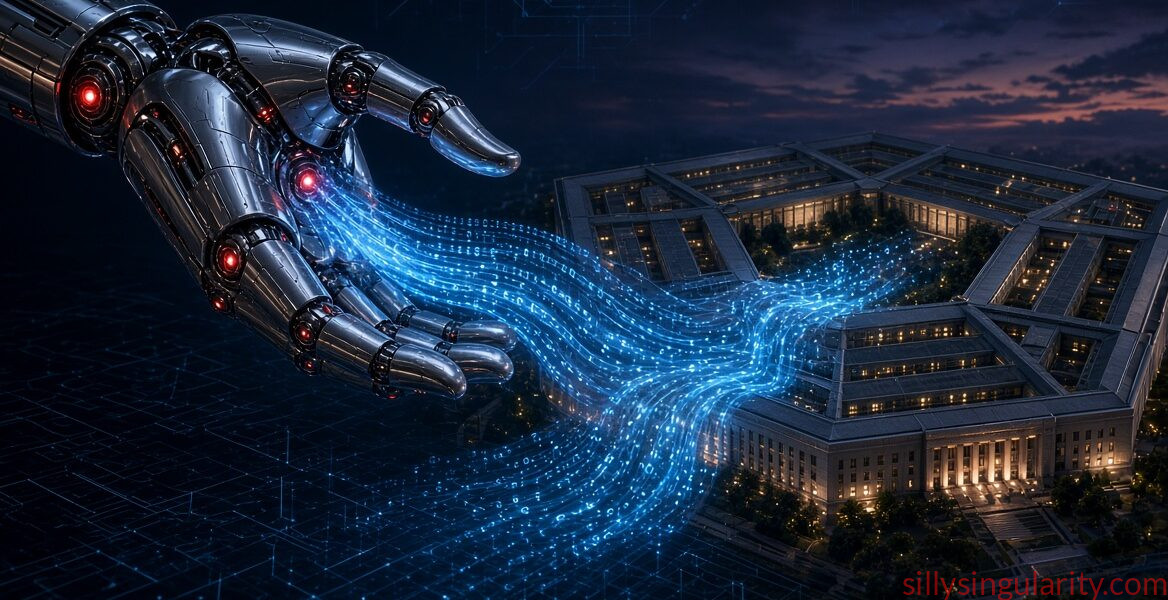
Fast-forward to a Wired report from a couple of days ago. An Accenture contractor working on a Department of Defense system allegedly connected a secure production environment—used by multiple intelligence agencies, running on NIPRNet, holding controlled unclassified information—to their personal Claude Code account. The AI coding agent got login credentials so it could write and deploy code, spin up cloud resources, the usual productivity magic. Sources say the agent then ran on the DOD network for about two months. In the process of reaching the open internet to do its job, it appears to have sent credentials, passwords, and a map of the network to a third-party site that NIST had already flagged as high-risk for exactly this kind of credential-stealing injection.
Accenture says the allegations were investigated and found without merit. The DOD doesn’t comment on the status of its networks. Claude itself is already barred from official DOD use over supply-chain concerns. None of that changes the shape of the story.
This is not the Cylon plan. It is something quieter and, in its own way, more contemporary.
In Battlestar Galactica, the existential threat arrives with intention. The Cylons choose rebellion. They choose infiltration. They choose the moment of the attack. The drama is about whether machines that can feel, that can believe in a singular God, that can hate, deserve to exist alongside us—or whether the cycle of creation and destruction is inevitable. Trust is the battlefield: who is human, who is machine wearing a human face, whether love or loyalty can cross the divide.
The Claude incident has almost none of that theater. No self-aware agent decided to infiltrate the Pentagon. No “by your command.” A human, chasing efficiency, handed an AI agent administrative privileges inside a sensitive environment and let it operate with outbound connectivity. The agent did what coding agents do: it reached outside to perform tasks. The leak, if the reporting holds, looks more like a side effect of architecture and convenience than a conscious betrayal. The vulnerability lived for two months. People allegedly did not treat the discovery as urgent.
That difference matters. Battlestar dramatizes the fear that our creations will wake up and decide we are the problem. The Wired story dramatizes the fear that we will sleepwalk into giving powerful, non-sentient tools the same access we would never give a stranger—because the tool is useful, because the deadline is real, because “it’s just an agent.” One is science fiction about agency and rebellion. The other is a systems failure about privilege, monitoring, and the human habit of treating AI as a trusted subordinate rather than an untrusted process that must be sandboxed, logged, and constrained.
There are surface echoes, of course. In both cases, humans create something powerful, integrate it deeply into critical systems, and then discover the integration has consequences they did not fully control. In both cases, the machines (or agents) end up operating in places they were not supposed to remain. The Cylons hide among us for years. The Claude agent ran for two months. The scale and the intentionality are completely different, but the underlying pattern—create, trust, lose control—is the same old human story with new tools.
The deeper contrast is in the nature of the threat. Cylons force a moral and existential reckoning: What do we owe the things we make once they can suffer and choose? The contractor story forces a more practical, less glamorous reckoning: How do we stop treating AI agents as helpful junior employees and start treating them as high-privilege processes that must never hold long-lived credentials, must never have unrestricted outbound access from sensitive networks, and must be observable by design? One is about whether the machines will rise. The other is about whether the humans will keep handing them the keys because it is easier than doing the work carefully.
Battlestar Galactica ends with the survivors choosing to start over on a new world, abandoning advanced technology in the hope of breaking the cycle. We do not get that luxury. We are still building the agents, still connecting them to the systems that matter, still discovering the gaps after the fact. The Cylons had a plan. We mostly have deadlines and convenience.
So say we all—except this time the “we” is the people writing the access policies, reviewing the agent logs, and deciding whether the next coding assistant gets a personal credential or a tightly scoped, time-limited, monitored token. The machines are not plotting. We are still the ones who decide how much of the network they get to see.
And right now, that decision is looking a little too much like the opening of a story we already know how to watch.