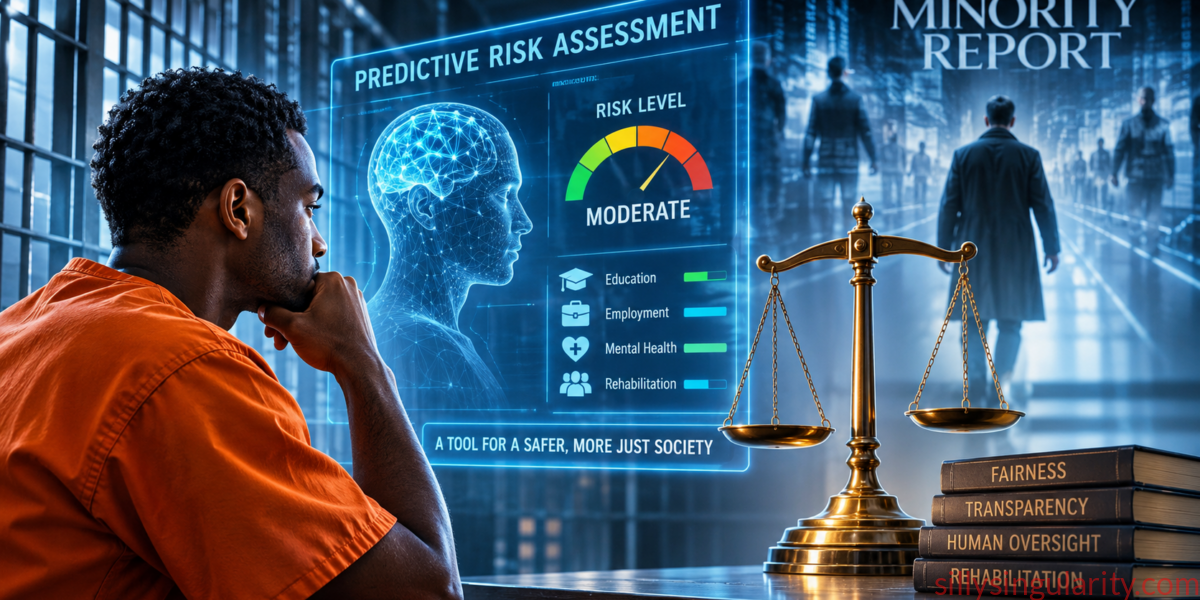
An exploration of AI-driven incarceration predictions, ethical responsibility, and the warning offered by the film Minority Report.
Introduction: When Predicting the Future Affects Justice
The intersection of artificial intelligence and criminal justice presents one of the most consequential ethical challenges of our time. AI promises to make criminal justice systems more efficient, consistent, and potentially more effective at preventing harm. It also raises a troubling question: At what point does predicting someone’s likelihood of committing a crime become punishing them for something they have not done?
This tension is particularly relevant to the use of predictive algorithms in prisons, parole decisions, sentencing, and assessments of recidivism. The prospect of using data to anticipate criminal behavior has undeniable appeal. Yet it also evokes the central premise of the 2002 science-fiction film Minority Report, in which authorities arrest individuals before they commit crimes.
Although today’s AI systems are far removed from the fictional precognitive technology in that film, the philosophical question is remarkably similar: Should society use predictions about the future to restrict someone’s freedom in the present?
The answer should not be an outright rejection of AI. Rather, it should be a thoughtful framework that distinguishes between using technology to improve rehabilitation and public safety and allowing algorithms to determine an individual’s fate.
1. When Algorithms Enter the Prison System
Recent reporting has highlighted efforts to introduce AI-assisted systems into prison classification and security decisions. These systems are intended to help correctional administrators assess incarcerated individuals and determine appropriate housing, supervision, and security arrangements.
Historically, such decisions have relied heavily on correctional staff, institutional experience, and established classification procedures. Algorithmic analysis introduces another layer of information into a process that can have profound consequences for incarcerated individuals.
A system that improves the prediction of future violence could be valuable. However, a claimed improvement in predictive accuracy is not, by itself, evidence that the system will produce better or fairer outcomes. We need to know what is being predicted, how accuracy is measured, what data informs the predictions, and whether the results apply consistently across different populations.
One particularly troubling issue is that an algorithm may identify patterns in historical data without understanding the circumstances behind them.
A prior arrest, a person’s neighborhood, socioeconomic circumstances, institutional history, or associations with other individuals may become predictive variables. But these factors do not necessarily establish that someone is dangerous. They may instead reflect unequal policing, differences in access to legal representation, poverty, or other systemic inequalities.
The possibilities are therefore competing:
- A better-informed corrections system: AI could help identify genuine institutional safety concerns while identifying individuals suitable for less restrictive housing, rehabilitation programs, and community reintegration.
- A more sophisticated system of institutional bias: AI could turn historical inequalities into mathematical classifications that appear objective, making discriminatory outcomes harder to identify and challenge.
The technology itself does not determine which outcome will prevail. Its design, data, implementation, oversight, and purpose will.
2. The Legitimate Benefits of AI in Corrections
It would be a mistake to approach AI in criminal justice exclusively through fear. Properly designed and responsibly deployed systems could address some longstanding weaknesses in corrections.
Improved consistency in decision-making
Human classification decisions can be affected by fatigue, individual judgment, unconscious bias, incomplete information, and inconsistent institutional practices.
An appropriately validated algorithm could help standardize how relevant information is considered across facilities. It could identify inconsistencies, flag overlooked information, and provide correctional professionals with a more comprehensive picture of an individual’s circumstances.
Importantly, consistency does not automatically equal fairness. A consistently applied discriminatory model remains discriminatory. Nevertheless, standardization can provide a foundation for more accountable decisions.
Better allocation of rehabilitation resources
One of the most promising applications of AI is identifying individuals who could benefit from particular interventions.
Analytical systems might help correctional professionals identify people who would benefit from:
- Educational opportunities and vocational training.
- Substance-use treatment and mental health support.
- Anger management and conflict-resolution programs.
- Employment preparation and transitional housing.
- Family reunification and community reintegration.
Rather than simply predicting who might commit another offense, AI could help identify what interventions are most likely to reduce that possibility.
This represents an important philosophical shift: from predicting dangerousness to identifying opportunities for positive change.
Improved institutional safety
Prisons are complicated environments in which staff must manage competing safety concerns, interpersonal conflicts, gang-related tensions, and individual vulnerabilities.
AI could help identify patterns that might otherwise go unnoticed. For example, it could flag emerging patterns of violence, identify circumstances associated with escalating conflicts, or help administrators assess whether particular housing arrangements are creating unnecessary risks.
Used appropriately, these capabilities could protect correctional officers and incarcerated individuals alike.
More informed decisions about housing and release
Risk assessments could also help identify individuals who are suitable for lower-security housing, expanded privileges, educational programs, or supervised community reintegration.
This is particularly important because prison classification is not simply an administrative exercise. It influences an individual’s daily life, personal safety, access to programs, opportunities for rehabilitation, and sometimes prospects for release.
3. The Minority Report Dilemma: When Prediction Becomes Punishment
The comparison between AI-assisted prison classification and Minority Report is compelling, but it deserves some qualification.
Directed by Steven Spielberg and based on a story by Philip K. Dick, the 2002 film imagines a future in which a specialized police unit uses predictions of future murders to arrest people before they commit the crimes.
In the film, three individuals known as Precogs possess the ability to foresee murders. Their predictions are treated as virtually infallible, and the Precrime unit uses those predictions to arrest individuals before any criminal act has occurred.
The moral conflict emerges when the film challenges the assumption that a predicted crime is an inevitable crime.
What if circumstances change? What if the individual makes a different choice? What if the prediction is wrong? And perhaps most importantly, what happens when society begins treating a forecast as proof?
These questions are directly relevant to AI-assisted corrections, although the circumstances are not identical.
Modern prison classification systems are intended to assess people who are already incarcerated, not to arrest members of the general public for crimes they have yet to commit. Their immediate purpose is institutional placement and security classification rather than preemptive criminal prosecution.
Nevertheless, the underlying philosophical risk is similar: an algorithm assigns a prediction about future behavior, and that prediction influences how an individual is treated.
Consider the implications.
An incarcerated person who has demonstrated good behavior, participated in rehabilitation, and made substantial personal progress could nevertheless receive an unfavorable risk classification because of historical data or statistical characteristics associated with a particular population.
The classification could then influence housing assignments, access to educational opportunities, privileges, and potentially the individual’s ability to demonstrate readiness for release.
The prediction risks becoming self-fulfilling.
A person classified as high risk may be placed in a more restrictive environment, receive fewer rehabilitative opportunities, and experience greater institutional stress. Those circumstances could make successful rehabilitation more difficult.
The algorithm may then interpret subsequent outcomes as confirmation that its original prediction was correct.
This is one of the most troubling possibilities in predictive justice: the system may create the conditions that reinforce the very outcome it claims merely to predict.
There is another important lesson in Minority Report: the danger does not necessarily come from technology malfunctioning. It can come from people placing excessive faith in technology and allowing institutions to use it without meaningful scrutiny.
The film’s Precrime system is presented as a tremendous public-safety success. Yet its apparent perfection masks institutional weaknesses, conflicts of interest, and the absence of meaningful safeguards.
That is perhaps the most relevant comparison to today’s AI debate.
We should not fear AI because it can make predictions. We should be cautious because institutions may treat those predictions as facts.
4. The Ethical Distinction: Predicting Risk Versus Identifying Potential
A responsible approach to AI in corrections requires a fundamental change in how we frame the problem.
Instead of asking:
How likely is this person to commit another crime?
We should also ask:
What circumstances, resources, and interventions would help this person avoid future criminal behavior?
These questions may sound similar, but they lead to very different outcomes.
The first focuses on identifying threats. The second focuses on reducing the likelihood of harm through constructive intervention.
An effective corrections system needs both public-safety awareness and a commitment to rehabilitation. AI can help connect these objectives.
For example, an algorithm might identify that an individual has characteristics associated with a higher statistical likelihood of recidivism. Rather than automatically imposing greater restrictions, the system could help identify the underlying needs that might be addressed.
Perhaps the individual lacks stable housing, employment opportunities, substance-use treatment, or access to educational resources.
The appropriate response may not be more restrictive confinement. It may be better access to the resources that reduce the likelihood of reoffending.
This is an important distinction between a punitive application of predictive technology and a rehabilitative one.
The National Institute of Justice’s guidelines for post-sentencing risk assessment identify fairness, efficiency, effectiveness, and communication as important principles. They emphasize that risk and needs assessments should help direct supportive and therapeutic resources to individuals who need them.
Read: National Institute of Justice – Guidelines for Post-Sentencing Risk Assessment
5. What Ethical AI in Corrections Should Look Like
If AI is going to become part of the criminal justice system, its implementation should be governed by principles that protect individual rights while allowing society to benefit from technological progress.
1. Human judgment must remain central
AI should inform decisions, not make final determinations about a person’s liberty, security classification, or rehabilitation opportunities.
Correctional professionals should be able to examine the algorithm’s recommendations, consider information the system may have overlooked, and override its conclusions when circumstances warrant.
Human oversight must be meaningful. A staff member who automatically accepts every algorithmic recommendation is not exercising independent judgment.
2. Algorithmic transparency must be mandatory
Incarcerated individuals should have the right to understand why they received a particular classification.
If an algorithm identifies someone as a high-risk individual, the institution should be able to explain the principal factors contributing to that determination.
Proprietary software should not become an excuse for withholding explanations from people whose lives are affected by its recommendations.
The government should also disclose how the system was developed, what data it uses, how its accuracy is measured, and what limitations have been identified.
3. Historical bias must be identified and actively addressed
An algorithm learns from the information it receives. If that information reflects historical discrimination, unequal enforcement, or inconsistent recordkeeping, the algorithm can reproduce those patterns.
For example, using arrest records as a proxy for criminal behavior can be problematic because arrests reflect policing practices as well as underlying behavior.
Developers must examine the quality and representativeness of the data, evaluate outcomes across demographic groups, and investigate disparities.
Simply removing race from the dataset is not enough. Other variables, including geography and socioeconomic circumstances, may function as indirect proxies.
4. Predictions must be regularly reassessed
A risk classification should not become a permanent label.
People change. They mature, acquire new skills, overcome substance-use problems, develop healthier relationships, and demonstrate sustained behavioral improvements.
An individual’s current circumstances should carry meaningful weight.
AI systems should be periodically reevaluated, and classification decisions should be updated when new evidence becomes available.
5. Individuals must have the right to challenge decisions
An incarcerated person should be able to question inaccurate information, challenge an unfavorable assessment, and request an independent review.
There must be a meaningful appeals process, not simply an opportunity to ask the same algorithm to reconsider its own conclusion.
A system that can significantly affect someone’s living conditions and future opportunities must also provide a mechanism for correcting mistakes.
6. Success should be measured by human outcomes, not just predictive accuracy
This may be the most important safeguard.
A corrections department should not judge an AI system solely by whether it improves its ability to classify people according to future risk.
It should also measure whether the system:
- Reduces violence and serious institutional incidents.
- Improves access to rehabilitation and educational programs.
- Reduces unnecessary restrictions and inappropriate security classifications.
- Improves successful reintegration into society.
- Reduces recidivism without creating new demographic disparities.
- Improves the safety and working conditions of correctional staff.
The U.S. Department of Justice’s report, Artificial Intelligence and Criminal Justice, provides a useful foundation for these principles. It recommends careful assessment of system objectives, data quality, bias, validation, transparency, stakeholder participation, and ongoing oversight.
Read: U.S. Department of Justice – Artificial Intelligence and Criminal Justice
The National Institute of Standards and Technology also provides an AI Risk Management Framework designed to help organizations incorporate trustworthiness considerations into the development, deployment, and evaluation of AI systems.
Read: NIST AI Risk Management Framework
These are not merely technical considerations. They are essential elements of responsible governance.
6. A Better Vision: AI as a Tool for Rehabilitation, Not Institutional Control
There is an opportunity here to rethink the purpose of correctional institutions.
Traditionally, prisons have been designed primarily around confinement, security, and punishment. Rehabilitation has often been an important but secondary objective.
AI could help change that balance.
Imagine a corrections system in which AI continuously analyzes relevant information to identify opportunities for individualized rehabilitation.
Rather than assigning someone a static risk label, the system could help create a dynamic rehabilitation plan.
| Traditional application | More constructive AI application |
|---|---|
| Predict likelihood of future violence | Identify factors contributing to conflict and violence |
| Assign restrictive housing based on risk | Identify the least restrictive safe housing environment |
| Classify individuals as high or low risk | Identify individual needs and opportunities for improvement |
| Flag potential recidivism | Recommend targeted rehabilitation interventions |
| Identify individuals unlikely to succeed | Identify barriers to successful reintegration |
| Use historical behavior to determine future treatment | Incorporate current progress and demonstrated behavioral change |
This does not mean eliminating security classifications or ignoring legitimate risks.
Prisons have a responsibility to protect incarcerated individuals, employees, and the broader community. There will always be circumstances in which additional supervision or restrictions are necessary.
But those decisions should be grounded in current evidence, proportionality, and individual circumstances rather than an unquestioned statistical prediction.
The most effective AI system would not simply tell correctional officers whom to watch more closely. It would help them understand how to reduce the need for that additional supervision.
7. The Danger of Confusing Probability with Destiny
The most important lesson from Minority Report is that the future is not necessarily predetermined.
AI systems identify statistical relationships. They do not possess an inherent understanding of human intention, personal growth, moral responsibility, or the capacity for change.
A person who has committed a crime is not necessarily destined to commit another.
Likewise, a person who has never committed a violent offense should not be treated as though they have simply because an algorithm identifies statistical characteristics associated with violence.
There is a profound difference between identifying an elevated probability and establishing that an individual will engage in harmful behavior.
That distinction must remain central to any ethical application of predictive technology.
There is also an important question of accountability.
If an AI system recommends an unfavorable classification and a correctional official follows that recommendation, who is responsible if the decision proves harmful?
Is it the software developer? The corrections department? The individual who approved the recommendation? The institution that selected the system?
The answer cannot be that the computer made the decision.
AI has no moral agency. It cannot be held accountable in the way a person or institution can. Responsibility must remain with the humans and organizations that develop, purchase, deploy, and act upon its recommendations.
That is why meaningful oversight and clear lines of institutional accountability are indispensable.
Conclusion: The Future of Justice Must Remain Human
The use of artificial intelligence in the criminal justice system illustrates both the promise and the danger of technological progress.
AI has the potential to improve institutional safety, standardize decision-making, identify rehabilitation opportunities, and help corrections departments use limited resources more effectively.
Those are worthwhile objectives.
But technological sophistication does not automatically produce justice.
A system can be statistically accurate and still be unfair. It can be consistent and still perpetuate discrimination. It can improve operational efficiency while undermining the dignity and rights of the people it is intended to manage.
The comparison with Minority Report should not be dismissed as science-fiction alarmism. The film offers a valuable warning about what can happen when society places too much confidence in predictions and too little emphasis on individual freedom, human judgment, and institutional accountability.
At the same time, we should not reject AI simply because it introduces difficult ethical questions. Used responsibly, it could help create a more effective, humane, and rehabilitative criminal justice system.
The distinction lies in how we choose to use it.
If AI becomes a mechanism for labeling people according to what an algorithm believes they might do, we risk creating a system in which individuals are increasingly defined by their predicted futures rather than their actual conduct.
If, however, AI is used to identify opportunities for rehabilitation, improve institutional safety, and ensure that individuals receive appropriate support and fair consideration, it could become an important instrument of meaningful criminal justice reform.
The ultimate test of AI in corrections should not be how accurately it predicts who might fail. It should be how effectively it helps people succeed.
And perhaps that is the most important difference between the world of Minority Report and the future we should strive to create: In a just society, a prediction should never become a person’s destiny.
References and Further Reading
- Futurism – Reporting on AI-assisted prison classification and predictive algorithms.
- U.S. Department of Justice – Artificial Intelligence and Criminal Justice, December 2024.
- National Institute of Justice – Guidelines for Post-Sentencing Risk Assessment, 2021.
- Richard A. Berk – Artificial Intelligence, Predictive Policing, and Risk Assessment for Law Enforcement, Annual Review of Criminology, 2021.
- National Institute of Standards and Technology – AI Risk Management Framework.
- Minority Report, directed by Steven Spielberg, based on the short story by Philip K. Dick, 20th Century Fox, 2002.



Solid piece. Balanced without being soft, and the Minority Report framing lands because it refuses the easy sci-fi panic.The core tension is correctly identified: prediction is not destiny, yet institutions love treating statistical outputs as if they were. The article does the useful work of separating “this person has elevated risk factors” from “therefore lock them down harder and call it justice.” That distinction matters more than most of the breathless AI-ethics commentary floating around.
A few points that hit particularly cleanly:
The self-fulfilling prophecy risk is real and under-discussed. High-risk classification → more restrictive housing / fewer programs → worse outcomes → “see, the model was right.” That’s not intelligence; that’s feedback-loop laundering of institutional choices.
Shifting the question from “how likely to reoffend” to “what interventions actually reduce that likelihood” is the right philosophical move. Risk scores without a corresponding needs/intervention layer are just expensive labeling.
The insistence on human override, transparency, and measurable human outcomes (not just AUC scores) is the minimum viable ethics package. Proprietary black boxes deciding someone’s housing and program access should be a non-starter.
Where it could push harder: the data problem is deeper than “historical bias.” Arrest records, disciplinary tickets, and neighborhood variables are downstream of enforcement priorities, plea practices, and resource allocation. Cleaning the labels is harder than most vendors admit, and simply auditing for demographic parity after the fact is theater if the training distribution itself encodes the inequality.
Also worth noting: the constructive vision (AI as continuous rehabilitation planner rather than static risk stamp) is attractive, but it assumes the surrounding system is actually interested in rehabilitation over throughput and liability management. Technology does not rewrite institutional incentives by itself.
Overall: measured, clear-eyed, and refreshingly free of both techno-utopianism and reflexive Luddism. The final line is the one that should stick—“a prediction should never become a person’s destiny.” That’s the test. Everything else is implementation detail.